Corpus Christi Procession

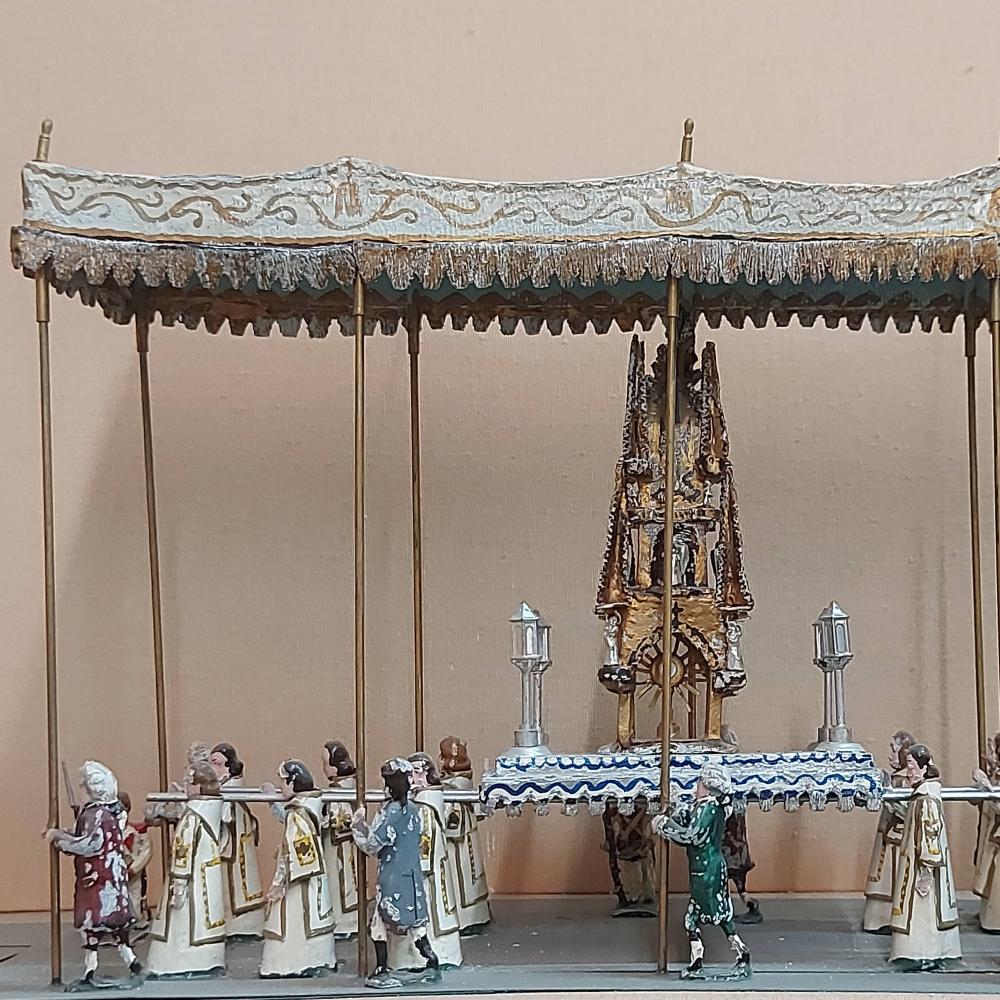
Maqueta de la procesión del Corpus Christi de Valencia en miniatura, 1.216 figuras de 45 mm obra de Vicente Juliá Chauve, Museo L'Iber

The Corpus Christi Room

The Corpus Christi Room at the L’Iber Museum occupies what was once the private chapel of the Palace of the Marquises of Malferit, one of the finest surviving examples of Mediterranean Gothic palace architecture on the historic Calle Caballeros in Valencia. The earliest records of the palace date back to the Llibre de Repartiment of 1277, linked to the Mercader lineage, and its construction took place in the late 14th and early 15th centuries. The chapel that now houses this room preserves its original Baroque altar in carved wood, the confessional doors with their characteristic pierced latticework, the Manises ceramic floor with its geometric patterns in ochre and white, and a period chandelier that recalls the space’s original liturgical use. On the main altar, beneath a carved and polychrome wooden altarpiece topped with a sunburst, a small-format image of the Virgen de los Desamparados, patron saint of Valencia, is venerated, surrounded by golden fabric flowers. The ensemble conveys the devout sobriety typical of Valencian noble chapels of the Baroque period. Malferit Palace

This singular architectural setting is the perfect stage for the museum’s most intimately Valencian collection: four Corpus Christi processional models from different countries and eras, along with a series of pieces of great historical and devotional value.

The Chauve Model: The Valencian Procession of 1800

The centerpiece of the room is the celebrated model of the Corpus Christi procession of Valencia, the work of miniaturist Vicente Juliá, known by the name of his Madrid workshop, Chauve. With 1,216 hand-painted lead figures measuring 45 mm and a length of over 27 meters, it is the most monumental piece in the museum’s Valencian collection and one of the most singular works in the world of miniature art. It was commissioned by Álvaro Noguera Giménez, founder of the museum, and was inspired by the watercolors that the Valencian Carthusian friar Fray Bernardo Tarín y Juaneda painted in 1913 to document the procession as it was celebrated around the year 1800. The diorama faithfully traces, with ethnographic accuracy, the complete processional order: the gegants and cabuts (giants and big-heads), the ball de la Moma dance, the biblical figures of the Old Testament, the parishes with their patron saints, the historic guilds with their banners, and, closing the procession, the Monstrance under its canopy along with the city’s civil authorities. More about the origin and content of this work can be read in the museum’s blog article.

The Austrian Procession: Wiener Zinnfiguren by Peter Ewald Kovar

The room also houses an 18th-century Vienna Corpus Christi procession, made up of 406 figures, created by Wiener Zinnfiguren, the workshop of master craftsman Peter Ewald Kovar. Kovar began his work in 1963 and has since produced series dedicated to Austrian and European history, being inducted in 1972 into the Vienna Engravers’ Association and in 1978 into the Metal Founders’ Association. His figures are flat or semi-flat — the Central European Zinnfigur tradition — hand-engraved in slate and cast in tin alloy, following a technique dating back to the 18th century. The recreated procession reproduces the Eucharistic ceremonial of the imperial Habsburg court, with its characteristic solemnity and the prominence of religious orders and Viennese nobility. The comparison with the Valencian Chauve procession, nearly contemporary in time but radically different in culture and aesthetics, is one of the most compelling dialogues in the room. Kovar

The Cabalgata del Convite: A Unique Chauve Piece

The second work by Vicente Juliá Chauve present in the room is the Cabalgata del Convite (Cavalcade of the Invitation), a unique piece created on commission and to the design of Álvaro Noguera himself. Made up of 164 figures at 18 mm scale, it is the smallest miniature in the room and one of the most technically demanding in the entire collection. The Cabalgata del Convite is the festive event that precedes the solemn Corpus procession in Valencia: a parade of heralds on horseback, children’s dances, musicians, civic representatives, and bearers of the Royal Senyera, ending with the famous “degolla” that winds through the city streets to announce the festival to its citizens. At this minimal scale, Chauve once again demonstrated his absolute mastery of detail and visual narrative in miniature.

The French Procession: CBG-Mignot, Early 20th Century

The fourth processional model is an early 20th-century French Corpus Christi procession, with 151 figures at 54 mm, made by CBG-Mignot, the oldest toy soldier maker in the world, based in France. Founded in Paris in 1825 and established in Saumur since 1994, CBG-Mignot carries on the great tradition of handcrafted toy soldiers, with a fundamentally manual character that means no two figures are exactly alike. The figures in this procession, with their unmistakable ronde-bosse craftsmanship and vivid Belle Époque color palette, bring a naïve perspective to the room on the same religious festival, more in keeping with the republican solemnity of turn-of-the-century France. Destination Saumur Val de Loire

Sant Antoni del Porquet

Among the singular pieces that round out the room is a notable 17th-century polychrome wood carving of Saint Anthony Abbot, popularly known in Valencia as Sant Antoni del Porquet (“Saint Anthony of the Little Pig”) after the piglet that always accompanies his image. Saint Anthony Abbot, a 3rd-century hermit considered the father of Christian monasticism, is one of the most deeply rooted saints in Valencian popular devotion. His iconographic attributes are unmistakable: the monastic habit, the tau-shaped staff, the bell, and the small pig at his feet. The museum’s carving was exhibited at “La Gloria del Barroco,” an exhibition organized by the Fundación La Luz de las Imágenes at the Church of San Martín Obispo in Valencia, dedicated to Valencian sculpture and goldsmithing from the medieval period to the 20th century.

The Zucchetto of Pius XII

Above the altar, in a wood-and-glass display case, is preserved a white zucchetto belonging to Pope Pius XII (Eugenio María Giuseppe Giovanni Pacelli, Rome 1876 – Castel Gandolfo 1958), gifted to the Noguera family. The papal zucchetto — the small white silk skullcap worn by the pope — is one of the most cherished secular relics among the Catholic faithful, since tradition allows those who greet the pope to exchange their own zucchetto for his. This piece, kept in its original display case, stands as a personal testimony of devotion.

A Space That Is Also Heritage

The room is not merely a place for the collection: it is itself a piece of heritage. The palace preserves artistically crafted ceilings, from traditional carved and polychrome wooden alfarje ceilings to Renaissance coffered ceilings, floors and skirting boards clad in Manises ceramic, and woodwork that may date back to the 18th century. The confessional doors, with their pierced wooden latticework in the form of a Baroque scallop shell and the small lower shelf for the kneeler, are an outstanding example of Valencian liturgical carpentry of the period. The Manises hydraulic tile floor, with its pattern of vegetal scrollwork in gold and white, also covers the raised presbytery where the altar stands, creating a decorative continuity that unifies the space. Iber Museum

Visiting this room means looking simultaneously at four national traditions that celebrate the same festival, and doing so from within a building that has been inhabited and prayed in since the 14th century.